
Medical Fraud, Waste and Abuse Training Course for Medicare/Medicaid
Online Medicare and Medicaid FWA prevention training with practical examples and a Certificate of Completion.
Healthcare employees make decisions every day that affect patient care, medical records, insurance claims, and payments. Knowing what to check and when to report a concern helps prevent inaccurate claims, unnecessary spending, and unsafe practices.
Supremus Group LLC’s Healthcare Fraud, Waste & Abuse Prevention Training is an online, self-paced course for healthcare professionals, administrative employees, managers, health plans, and relevant contractors. The course connects federal compliance topics to everyday work rather than asking learners to memorize legal terms without context.
The course contains 120 slides organized into 12 modules, with narrated lessons, practical examples, fictional scenarios, and explanations of appropriate responses. Topics include Medicare and Medicaid riskdes, documentation and billing, referral arrangements, exclusion screening, overpayment response, compliance programs, privacy safeguards, and brief AI awareness.
Prevent improper practices. Recognize warning signs. Report concerns. Support correction.
$25 per learner | Online, self-paced | Certificate of Completion
Course Details at a Glance
|
Course feature |
Details |
|
Course name |
Healthcare Fraud, Waste & Abuse Prevention Training |
|
Training provider |
Supremus Group LLC |
|
Price |
$25 per learner |
|
Format |
Online, self-paced training |
|
Course structure |
120 slides across 12 modules |
|
Audio |
Narrated instruction |
|
Learning activities |
Lessons, examples, scenarios, response explanations, and module reviews |
|
Assessment |
Course knowledge assessment |
|
Online access |
After 60 days, or once you start the test, whichever comes first, you will no longer have access to the course. |
|
License |
Single learner |
|
Completion document |
Certificate of Completion after meeting course requirements |
|
Certificate term |
One year under the course’s certificate policy |
The course access period and certificate term are different. Access determines how long the training remains available in your account. The certificate term follows the course’s policy and does not establish a universal legal deadline for refresher training.
Who Should Take This FWA Training?
This course is designed for people whose responsibilities involve healthcare services, patient information, documentation, claims, purchasing, payments, or compliance. It addresses clinical, administrative, management, and contractor roles.
Healthcare Providers and Clinical Teams
Physicians, nurses, therapists, pharmacists, clinical support staff, and other healthcare professionals can use the training to understand how actual care, accurate records, and appropriate orders support correct payment. Examples also address home health, hospice, nursing facilities, rehabilitation, and behavioral health services.
Billing, Coding, and Administrative Staff
Medical billers, coders, claims processors, registration employees, schedulers, medical records staff, and practice administrators encounter information that can affect a claim before it is submitted. The course helps these teams recognize unsupported codes, duplicate submissions, incorrect practitioner details, and documentation that needs clarification.
Managers, Finance Teams, and Compliance Personnel
Practice managers, healthcare supervisors, compliance staff, purchasing employees, and finance personnel review decisions involving vendors, incentives, payments, reporting, and corrective action. The training connects these responsibilities to practical controls and explains why productivity or revenue goals should not override accuracy.
Health Plans, Suppliers, and Healthcare Contractors
Examples address health plans, pharmacy benefit managers, laboratories, equipment suppliers, billing vendors, transportation providers, and medical courier services. The course distinguishes different services and payment arrangements. A rule for ambulance reimbursement, for example, should not automatically be applied to a specimen courier’s delivery contract.
Organizations should determine which employees and contractors need training based on their responsibilities and applicable requirements. Being included in this audience does not mean every role has the same legal training obligation.
What Will You Learn?
After completing the course, learners should be able to:
- Distinguish fraud, waste, abuse, and ordinary errors. Recognize why a questionable claim or improper payment needs review but does not automatically prove fraud.
- Recognize billing, documentation, and referral risks. Identify unsupported codes, inaccurate records, duplicate claims, improper incentives, and charges for services that were not delivered.
- Understand the purpose of major federal laws. Recognize issues involving the False Claims Act, Anti-Kickback Statute, Stark Law, exclusions, and protections for lawful reporting, and know when qualified review is needed.
- Support accurate claims and timely correction. Connect documentation to actual services, identify possible overpayments, and understand why a recurring problem requires more than correcting one account.
- Report concerns factually and securely. Identify useful information, preserve relevant records, protect patients, and stay within an authorized role rather than conduct an independent investigation.
- Apply controls to modern healthcare work. Recognize risks involving outsourced services, digital payments, telehealth, identity misuse, and inaccurate AI-generated information.
What Is Healthcare Fraud, Waste, and Abuse?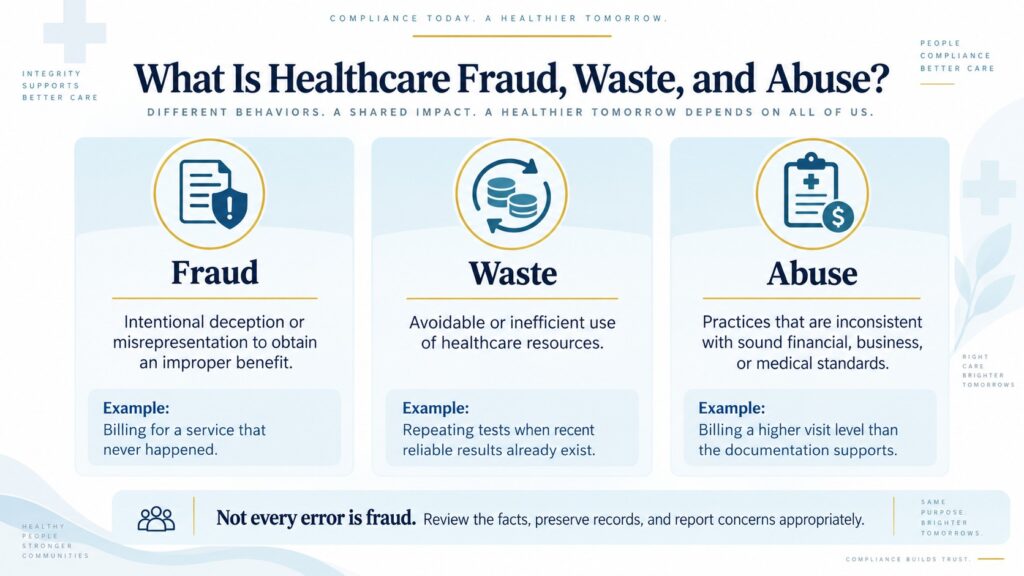
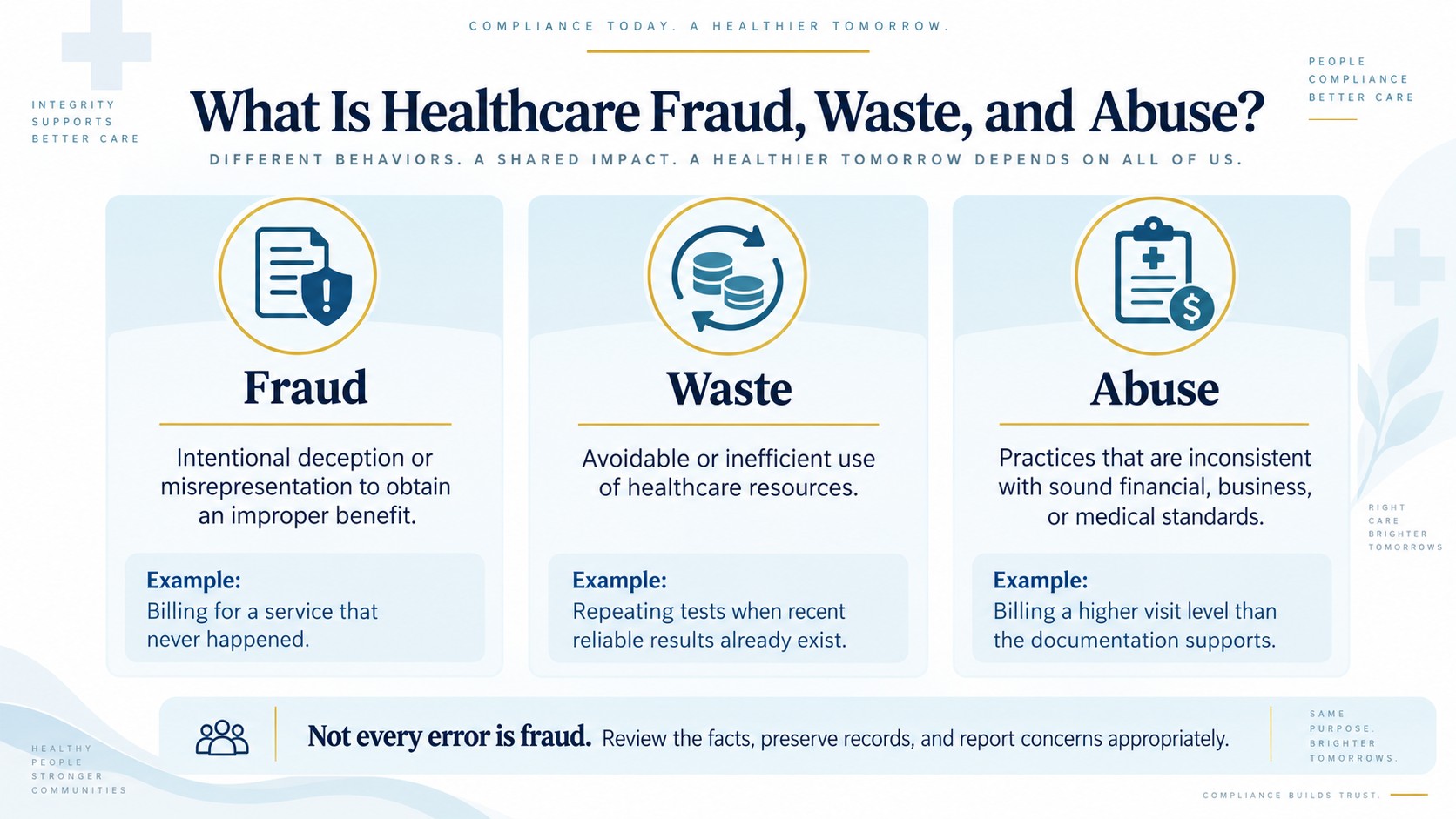
Healthcare fraud, waste, and abuse, often shortened to FWA, describe different problems that can create unnecessary costs, improper payments, or harm to patients. Understanding the differences helps employees recognize concerns without assuming that every mistake involves intentional wrongdoing.
Healthcare Fraud
Healthcare fraud generally involves deception or misrepresentation to obtain an improper benefit. Examples include deliberately billing for a visit that never occurred, creating false records to support payment, or knowingly claiming that equipment was delivered when it was not.
Example: A practice creates visit notes for appointments that did not take place and uses those notes to obtain reimbursement. Employees who notice the mismatch should preserve the relevant information and report the facts through an appropriate channel.
Different civil and criminal laws have different requirements. Employees should recognize questionable conduct without attempting to decide every legal element themselves.
Healthcare Waste
Healthcare waste involves avoidable or inefficient use of healthcare resources. Examples include unnecessary duplicate testing, inefficient administrative processes, poorly coordinated services, and excess supplies that expire before use. Waste does not necessarily involve intentional deception.
Example: A clinic routinely repeats laboratory testing without checking whether recent, reliable results are available. The process may create unnecessary costs, but the clinical circumstances still require review. Repeat testing can be appropriate when a patient’s condition changes or an earlier result is unreliable.
Preventing waste means reducing avoidable work and spending without restricting medically appropriate care.
Healthcare Abuse
Healthcare abuse generally involves practices inconsistent with sound financial, business, or medical standards that create unnecessary costs or improper reimbursement. Examples may include unsupported service levels, excessive billing units, or services that do not meet applicable medical-necessity requirements.
Example: A clinic regularly bills a higher visit level than the actual care and documentation support. Reviewers should examine the services, records, and payer rules before determining whether the pattern reflects an error, weak controls, abuse, fraud, or another concern.
A practice can need correction even when intentional deception has not been established. The appropriate response is to review the facts and address both the immediate problem and its cause.
An Honest Error Is Not Automatically Fraud
Incorrect codes, duplicate submissions, and payment discrepancies can occur without intentional wrongdoing. Two submissions for one visit might represent a legitimate correction, an accidental duplicate, or a deliberate scheme. The facts matter.
Under the civil False Claims Act, the term knowingly includes actual knowledge, deliberate ignorance, and reckless disregard. A specific intent to defraud is not required, although the other legal elements must still be established.
Ignoring credible information that claims are inaccurate can create additional risk. Staff should check facts within their responsibilities, report concerns promptly, preserve records, and follow approved correction procedures. A warning sign is a reason for review, not a finding of guilt.
Healthcare FWA Training Course Outline
The 12-module course follows the connection between actual care, accurate records, proper payments, and responsible reporting. Each module introduces its learning focus, and the course includes module-by-module reviews.
Module 1: FWA Foundations
Understand fraud, waste, abuse, and ordinary errors. Review how these concerns affect patients and healthcare resources, why the payer and employee’s role matter, and how to respond safely. A duplicate-claim scenario introduces a practical decision path: check, protect, preserve, and report.
Module 2: Laws and Obligations
Review the False Claims Act, Anti-Kickback Statute, Stark Law, exclusion risks, criminal laws, and protections for lawful reporting. Topics include gifts, patient assistance, referral arrangements, exclusion screening, and consequences. Learn why one arrangement may require review under several laws and why training duties vary by organization.
Module 3: Documentation and Billing
Follow the process from actual care to the claim and payment. Topics include medical necessity, coverage, authorization, copied notes, coding, modifiers, practitioner identity, supervision, time, and units. Practice responding to pressure to use an unsupported higher-paying code and learn why corrections must remain truthful and traceable.
Module 4: Risks Across Healthcare Settings
Examine risks in hospitals, practices, home health, hospice, nursing facilities, rehabilitation, behavioral health, pharmacies, laboratories, and equipment supply. The module also addresses transportation, medical courier workflows, health plans, risk-adjustment data, utilization review, and appeals. Learn to apply the requirements for the actual service while protecting appropriate access to care.
Module 5: Financial and Digital Workflows
Review conflicts of interest, patient assistance, purchasing, invoices, banking changes, and vendor oversight. Explore telehealth and remote-monitoring concerns, including orders without meaningful assessment and billing unsupported by qualifying work. Understand why a vendor assurance, device shipment, or automated record does not establish that every charge is correct.
Module 6: Recognizing Warning Signs
Identify objective discrepancies in claims, records, service quantities, and referral arrangements. Learn how analytics and patient questions can support review without replacing it. The module also covers identity misuse, medical identity theft, and enforcement examples. A warning sign should lead to a fair review of the circumstances, not an unsupported accusation.
Module 7: An Effective Compliance Program
Explore the seven compliance-program elements, including policies, leadership, education, communication, fair standards, risk assessment, auditing, monitoring, and corrective action. Learn how reporting channels, incentives, and follow-up affect daily work. Review why training completion alone does not demonstrate that a compliance program is effective.
Module 8: Reporting and Responding
Learn to report concerns promptly, factually, and securely. Topics include internal and external reporting, useful report details, evidence preservation, confidentiality, nonretaliation, and authorized investigations. Review how clinical, compliance, finance, privacy, security, and legal teams may coordinate a response without unnecessarily interrupting patient care.
Module 9: Overpayment Response
Recognize possible overpayments, including duplicates, incorrect rates, and unsupported services. Review Medicare Parts A and B identification, reporting, and return requirements, along with conditional investigation provisions. Learn why other payers require separate analysis and why returning one payment may not resolve a wider problem caused by the same system defect.
Module 10: Privacy and Identity Safeguards
Understand how privacy and identity safeguards support FWA prevention. Review HIPAA roles, business associate concepts, Medicare contracting terminology, and the applicability of the FTC Red Flags Rule. Learn why retention requirements depend on the record and why preservation instructions must be considered before routine destruction.
Module 11: Brief AI Awareness
Recognize how AI-generated notes, coding suggestions, and alerts can introduce false information or repeat errors. Practice reviewing a draft that invents a procedure. Learn to verify information against the actual encounter, use approved tools, correct unsupported content, and report recurring defects. This module provides focused awareness rather than a full AI compliance course.
Module 12: Putting the Course into Practice
Connect clinical, administrative, managerial, and contractor responsibilities to daily controls. A combined scenario examines prefilled testing orders, vendor promises, supervisor pressure, and a patient concern. Apply the four course actions: prevent, detect, report, and correct. Finish by identifying the reporting routes and local procedures relevant to your role.
Practice With Healthcare Workplace Scenarios
The course asks learners to consider fictional situations before reviewing the response. These examples focus on the next appropriate action rather than asking employees to make a final legal judgment.
Two claims for one visit: A patient reports duplicate charges, but one submission may be a correction. Learners practice checking the claim and payment history before drawing a conclusion and escalating confirmed errors for review.
Pressure to use a higher code: A supervisor asks for a more expensive billing level that the record does not support. Learners practice neutral clarification, qualified review, and reporting continued pressure without inventing findings, time, or services.
One refund reveals a wider problem: A confirmed duplicate payment points to a software setting that may affect other claims. Learners consider the affected accounts, ongoing billing, repayment review, and the need to correct and test the system setting.
An AI draft invents a procedure: A generated note includes care that never happened. Learners practice correcting the unsupported information, checking the rest of the draft, and escalating any affected finalized records or submitted claims.
A vendor pushes prefilled testing orders: Vendor promises and supervisor instructions conflict with a patient’s report that no clinician discussed the testing. Learners practice protecting necessary care, preserving the materials, and reporting the connected clinical, billing, and financial concerns.
How Does This Training Support Medicare and Medicaid Compliance?
The course introduces federal FWA concepts that organizations can use within their compliance education. It addresses Medicare and Medicaid risks while explaining why different programs, payment arrangements, and organizational roles require different analysis.
Medicare Advantage and Part D organizations have specific compliance-program requirements. Medicaid and other arrangements may involve separate federal, state, and contractual duties. Completing one course does not automatically satisfy every requirement applicable to an organization or employee.
Pair the training with local orientation covering reporting contacts, approved forms, documentation practices, payer instructions, privacy safeguards, and escalation procedures. Your organization should confirm that the course fits its training assignment and identify any additional role-specific instruction needed.
How Often Is FWA Training Required?
There is no single training schedule that applies to every healthcare employee or contractor. Medicare Advantage and Part D regulations require compliance training during orientation and at least annually for specified plan personnel and leadership. Other training obligations depend on the program, contract, state requirements, and organizational policies involved.
First-tier, downstream, and related entities should confirm their responsibilities under the relevant relationship and contract rather than assume that one deadline applies to every contractor. Follow your assigned training schedule and complete additional instruction when required for changes in your role, procedures, or applicable requirements.
Why Include This Course in Employee Training?
The course provides a common foundation for recognizing concerns across departments. Clinical staff, administrative employees, managers, and contractors can use the same four actions while applying the controls specific to their work.
Prevent: Use accurate records, appropriate services, reviewed arrangements, and approved workflows.
Detect: Notice discrepancies, listen to patient concerns, and review objective warning signs in context.
Report: Share relevant facts promptly through an appropriate channel without exposing unnecessary patient information.
Correct: Address inaccurate records or payments, identify the underlying cause, and check whether the fix works.
Training supports a broader compliance program that also includes policies, leadership, communication, monitoring, auditing, and follow-up. HHS OIG’s General Compliance Program Guidance is voluntary and nonbinding; separate laws, regulations, and contracts may impose specific obligations.
How the Online Course Works
Register the learner. Use the enrollment page and enter accurate student information. Training login details are sent to the email address supplied during registration.
Complete the lessons. Work through the narrated material during the access period. Pause to consider each scenario before reviewing the explanation, and revisit topics that need more attention.
Meet the assessment requirements. Complete the course knowledge assessment and follow the instructions provided in the learning account.
Keep the completion record. After meeting course requirements, retain the Certificate of Completion for your training records. Complete any separate policy acknowledgments or local orientation required by your organization.
Cost: $25
Buy Medical Fraud, Waste, and Abuse Prevention Training
Frequently Asked Questions
What does FWA stand for in healthcare?
FWA stands for fraud, waste, and abuse. The terms cover different concerns involving false or improper claims, unnecessary resource use, and practices outside sound financial, business, or medical standards. This course explains those differences and how employees should respond to potential problems.
Does this course cover both Medicare and Medicaid?
Yes. The course addresses Medicare and Medicaid topics, including claims, referrals, exclusions, compliance responsibilities, and overpayments. It also explains why a requirement for one program should not automatically be applied to another payer, service, or contract.
Will I receive an FWA training certificate?
Yes. A Certificate of Completion is provided after you meet the course requirements. The certificate term is one year under the course’s policy. Follow any separate training or renewal schedule assigned by your employer or applicable program. The certificate documents completion; it is not a professional license or a guarantee of organizational compliance.
Can I complete the training online at my own pace?
Yes. The course is online and self-paced, with narrated instruction and a 60-day access period. Learners can review the material during that period and follow the completion instructions in their training account. Course expires after 60 days, or once you start the test, whichever comes first, you will no longer have access to the course.
Will this course meet my employer’s or health plan’s requirements?
Your employer or health plan should review the course topics and completion documentation against its specific assignment. Additional instruction may be needed for state law, payer requirements, internal policies, or job-specific risks. No single general course replaces every organization’s compliance responsibilities.
Is FWA training the same as HIPAA training?
No. FWA training focuses on appropriate services, truthful documentation, accurate payment, reporting, and corrective action. HIPAA training addresses applicable health-information privacy and security duties. This course includes a focused privacy section, but it does not replace separate role-specific HIPAA training.
Can an organization register multiple employees?
Yes. The enrollment page allows multiple students to be added to an order. Each person should be registered as an individual learner using the correct student details and email address. Contact Supremus Group for help with team registration or course questions.
Does the course cover AI-related risks?
Yes. The Brief AI Awareness module covers verifying generated content, identifying invented procedures, using approved tools, and reporting recurring defects. It also reinforces that an AI-generated fraud alert is a lead for review, not proof of misconduct. Detailed AI instruction belongs in a separate course.
Does a completion certificate provide continuing education credit?
A Certificate of Completion and professional continuing education credit are different. Contact Supremus Group before registering to confirm whether CE credit is available for the current course and whether it meets your licensing board’s or employer’s requirements.
Testimonials
Very Informative Course. I would recommend.
Very useful info. Informative, and I can trust it is accurate.
It was a great experience I appreciate the opportunity to take the test I have also encouraged our colleagues in the industry to take the test.
This course was great and helped me a lot!
Great course, covered it all. Thanks
Thank you for your program and for the slide show.
An enlightening and lengthy training
Thank you for the course and information
I thought the course was very knowledgeable.
EASY TO UNDERSTAND AND VERY HELPFUL
This session was very informative!
Very insightful course and very well taught
Very interesting course. I have been in this industry for 30 years. good test.
Well-summarized introduction to the topic.
Great course and content, thank you!
The content was useful and helpful.
Interesting course that shows what healthcare fraud, waste and abuse in medicare and medicaid is.
I am truly thankful for this course. Really educative
Excellent course will recommend to others.
Great course. very helpful and informative
Thank you for creating this course, it has been helpful. Thanks!
This was a very well informed course. The detailed information was easy to understand.
The course was informational and a good refresher.
It was extremely informative and helpful.
Very enlightening, thank you once again
This course is very helpful. I will recommend it to anyone who would like to take a course about Medicare/Medicaid Fraud, Waste, Abuse.
This was very informational and helpful.
Great information in a convenient format
Good review of these regulations. Thank you!
Well conducted course. Easy to understand and complete.
This is very good training to review once a year.
Thank you! I learned a lot that can benefit me educating those I work with.
I enjoyed the course! The course was very informative and I learned information I did not know before.
Great training everyone should know about insurance fraud and what to do if this happens in your office. This training has been very great and very educational and I have enjoyed and learned a lot.
I enjoyed the course it was informative and covered many topics relevant to practicing medicine
Enroll in Healthcare Fraud, Waste & Abuse Prevention Training
Build the knowledge to recognize questionable practices, support accurate healthcare records and payments, and report concerns responsibly. Use practical examples to connect fraud prevention concepts to your everyday responsibilities.
$25 per learner | 12 modules | Online, self-paced | Certificate of Completion
Enroll in Healthcare FWA Training
For course questions or help enrolling your team, email Bob@training-hipaa.net or call 515-865-4591.
This course provides general education. It does not replace legal advice, payer-specific instructions, professional duties, or your organization’s policies and procedures.
USER RATING:
Medical Fraud, Waste and Abuse Training Course for Medicare/Medicaid is rated 4.7 out of 5 by 1618 users.