
HIPAA Awareness for Law Enforcement & Public Safety Professionals
Clear communication with healthcare staff helps a medical information request receive appropriate review. Public safety personnel need to explain why information is needed, identify the records they are seeking, and understand the limits that may affect a response.
This HIPAA awareness course examines the interactions between law enforcement, emergency services, corrections, and healthcare organizations. Lessons follow information from an initial request through later use, including custody transfers, reports, electronic messages, and recordings.
Participants explore the differences between police duties and covered healthcare activities. They also learn to recognize situations that require clarification, additional safeguards, or guidance from a privacy or legal contact.
Target Audience & Examples
Course Overview & Outline
Online Course Features
Course Video Demo
Sample Certificate
Roles Covered by the Training
The course is relevant to sworn officers and civilian personnel whose assignments involve health information or communication with healthcare organizations.
Examples include:
- Investigative personnel: Police officers, sheriff’s deputies, detectives, and investigators who seek information related to an incident or case.
- Emergency response teams: Firefighters, EMTs, paramedics, dispatchers, and emergency management personnel involved in response and information exchange.
- Custody and transport staff: Correctional officers, detention personnel, and employees coordinating safe transfers between facilities.
- School and campus safety personnel: Staff who may encounter both school-maintained records and information held by healthcare providers.
- Records and supervisory staff: Employees who support information handling, review requests, manage access, or provide workforce guidance.
Examples throughout the course show how information needs change with the person’s assignment, the intended recipient, and the reason for the request.
Course Overview
- Delivery: Online, self-paced learning.
- Course material: 112 slides across six modules.
- Course duration: 2 hours 12 minutes.
- Practice exercises: 19 fictional case scenarios, including a final integrated exercise.
- Learning approach: Illustrated explanations, reflection pauses, and guided case debriefs.
- Completion requirements: Course lessons and a separate assessment.
- Exam attempts: Unlimited.
- Completion record: Certificate of Achievement after successfully meeting the course requirements.
- Certificate validity: Two years from course completion.
Course Outline
Module 1: Foundations and Roles
Establish who holds the information and which responsibilities apply to each person involved. The module introduces protected health information, different record types, family involvement, and personal representatives. It also separates legal permission from legal duties and agency procedures.
Module 2: Medical Information Requests
Follow a request from initial contact through verification and review. Topics include authorizations, the minimum necessary standard and its exceptions, court orders, court-ordered warrants, subpoenas, and administrative requests. Learners also examine directory inquiries, missing-person requests, crime-victim information, and required reports.
Module 3: Emergencies and Investigations
Consider the facts that affect information sharing during urgent situations and criminal investigations. Examples address abuse reports, serious threats, suspicious deaths, crimes in healthcare settings, and emergency crime alerts. The module also covers behavioral health information, psychotherapy notes, welfare checks, responder exposure, and the distinction between existing test results and a request for a new biological sample.
Module 4: Custody and Handoffs
Examine how information should reach the people responsible for care, transport, and custody. Cases address different recipient needs, changed destinations, confirmation of receiving contacts, and conflicting instructions. Learners also consider why requests for later treatment records require fresh review after lawful custody ends.
Module 5: Responsible Information Handling
Review what happens after information has been received, including forwarding, recording, storage, vendor use, and public release. Lessons address dispatch entries, business associate relationships, body cameras, AI tools, and transcript accuracy. The module also explains incident reporting, evidence preservation, accountability, documentation, and retention.
Module 6: Additional Protections and Review
Recognize records that may require additional review under 42 CFR Part 2, FERPA, or state confidentiality requirements. Particular attention is given to restrictions on using Part 2 records in proceedings against a patient. The final lessons explain how to use agency guidance that has been completed and approved locally. The module also includes an integrated case exercise and a final review before the separate assessment.
Learning Outcomes
The course prepares participants to:
- Explain a medical information request clearly and identify the process needed for review.
- Recognize when an emergency, investigation, or custody situation requires a specific disclosure analysis.
- Match the requested information to the recipient’s responsibilities.
- Identify confidentiality restrictions that may continue when records change hands.
- Respond appropriately to mistaken disclosures, questionable access, or inaccurate AI-generated content.
- Record relevant decisions and direct unresolved questions to the appropriate agency or healthcare contact.
Flexible Study and Exam Attempts
- The course has a stated duration of 2 hours 12 minutes, with the flexibility to work through the material at your own pace.
- Unlimited exam attempts allow learners to review the lessons before trying again.
Case Practice and Guided Review
The course combines visual explanations with short decision exercises. Learners pause to consider a situation before reviewing the debrief, which explains the relevant facts and the questions that still need to be resolved.
A recurring five-check framework connects the lessons: source, purpose, authority, scope, and safeguards. Participants use these checks to examine an initial request and later actions, such as forwarding a record, uploading information, or considering public release. Documenting the decision is part of that process.
Examples of Questions Explored
- An unfamiliar caller knows the case number. What still needs to be verified before the request can proceed?
- A transport destination changes after hours. Who should receive the care information, and how should receipt be confirmed?
- An AI transcript assigns a medical statement to the wrong speaker. What should staff check before using the transcript?
Illustrations help distinguish the responsibilities of investigators, healthcare teams, dispatch personnel, and transport staff. Case feedback also addresses timely reporting of mistakes, preservation of original evidence, and escalation through approved channels.
Law Enforcement & Public Safety Professionals Training Demo
Law Enforcement & Public Safety Professionals Sample Certificate
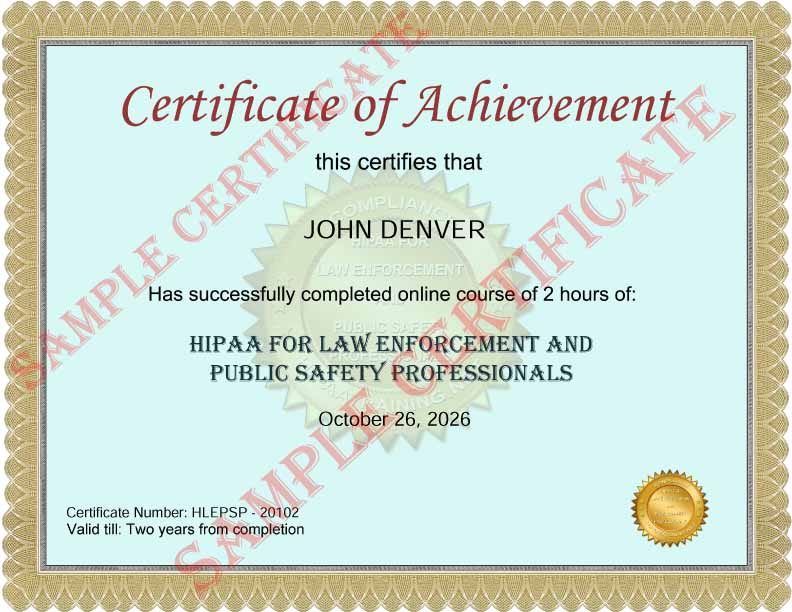
Print your HIPAA certification immediately online upon successful completion of each course
Your Course Completion Record
A separate assessment follows the course lessons, with unlimited exam attempts available. Learners who successfully complete the course requirements receive a Certificate of Achievement, valid for two years from course completion.
You can download or print your certificate for your training records.
Information requests and later uses of medical records still require the applicable legal basis and any necessary agency review or approval.
Certificate for Continuing Education Credits:
Students can buy a CE credits certificate for this course at the time of registration. You will receive one CE credit for this course through the Approved Provider of California Board of Registered Nursing after completing the course.
Email us now at Bob@training-hipaa.net or call (515) 865-4591 if you have any questions about this course and who should take this course.
Other One Hour HIPAA Certification Courses
Training Courses for OSHA and Medicare
Globally Harmonized System (GHS) for Hazard Communication Training
Course Duration: 30 minutes. Cost: $25. (self-paced with audio)
Online Bloodborne Pathogens Training
Course Duration: 1 hour. Cost: $25. (self-paced with audio)
Medical Fraud, Waste and Abuse Training Course for Medicare/Medicaid
Course Duration: 1.5 hours. Cost: $25. (self-paced with audio)
Certified CyberSecurity Awareness Professional Course
Course Duration: 4 hours. Cost: $45. (self-paced with audio)
Cost: $45 Buy Certified CyberSecurity Awareness Professional Course Now
Testimonials
- Great class. Very informative.
David McMenamy - Good Course. I would highly recommend it to others
Michael Szegda
HIPAA Awareness for Law Enforcement & Public Safety Professionals is rated 4.8 out of 5 by 74 users.